

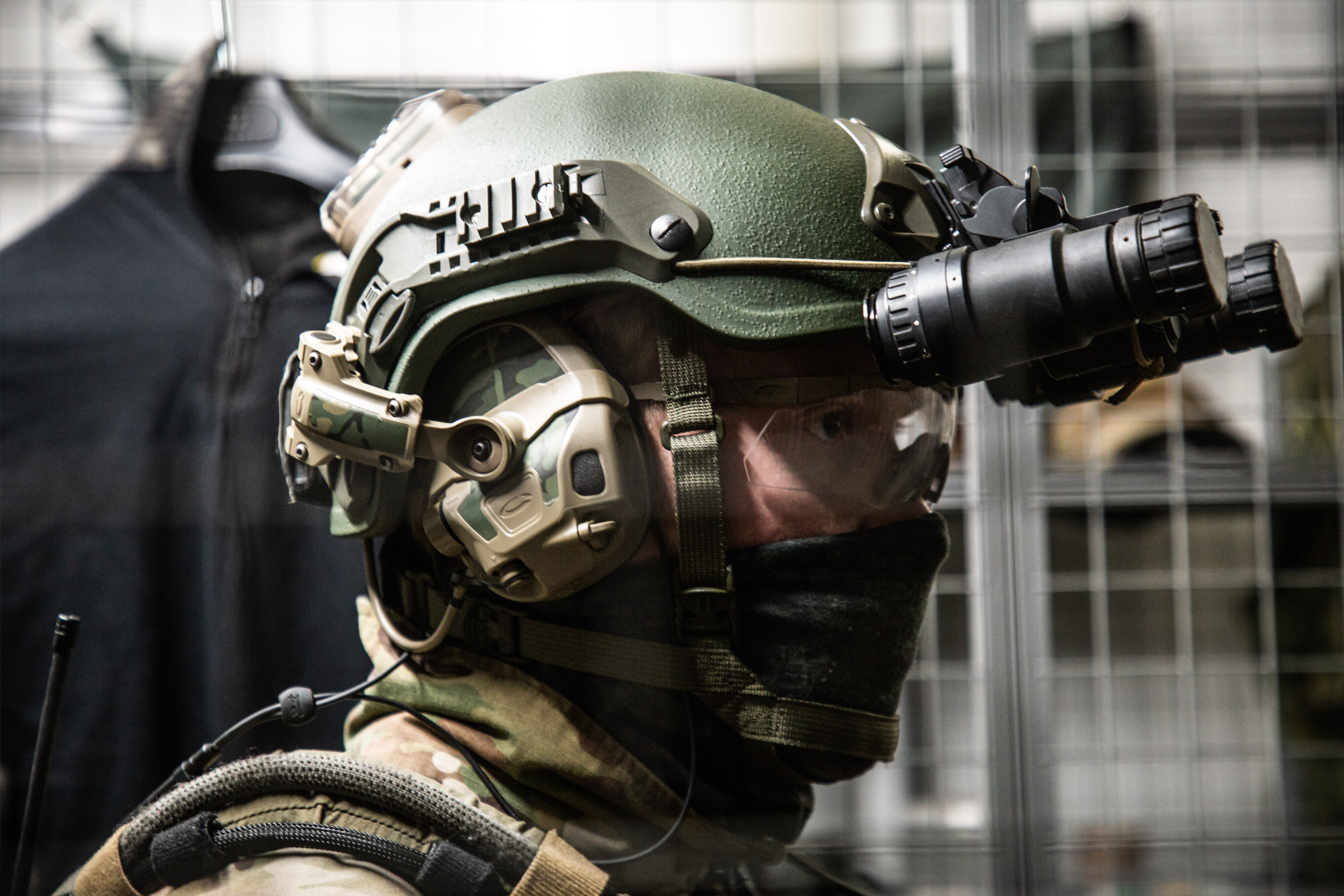
Here is something most people don’t expect: a helmet can stop a bullet completely, and the person wearing it can still be seriously injured.
To understand why — and why it matters when choosing helmets for soldiers, police officers and other frontline personnel — you need to look at what really happens in the split second a helmet is hit.
It is less obvious than it sounds.
What Is a Ballistic Helmet Made Of?
Most people picture a combat helmet as a steel bowl. That was once the standard. Modern ballistic helmets, however, are typically made from advanced fibres that offer significantly better strength-to-weight performance than traditional steel.
One of the most widely used materials is UHMWPE (Ultra High Molecular Weight Polyethylene). It is a polymer fibre, but its performance is far removed from what the word “plastic” might suggest. UHMWPE offers an exceptional strength-to-weight ratio, making it possible to design helmets that provide high levels of ballistic protection without unnecessary weight.
Layers of the material are consolidated under controlled heat and pressure to form the helmet shell.
How that shell is constructed matters too.
A seamless, one-piece shell eliminates joins and potential discontinuities in the protective structure. This can help provide consistent ballistic performance across the protected area.
Is There Such a Thing as a Bulletproof Helmet?
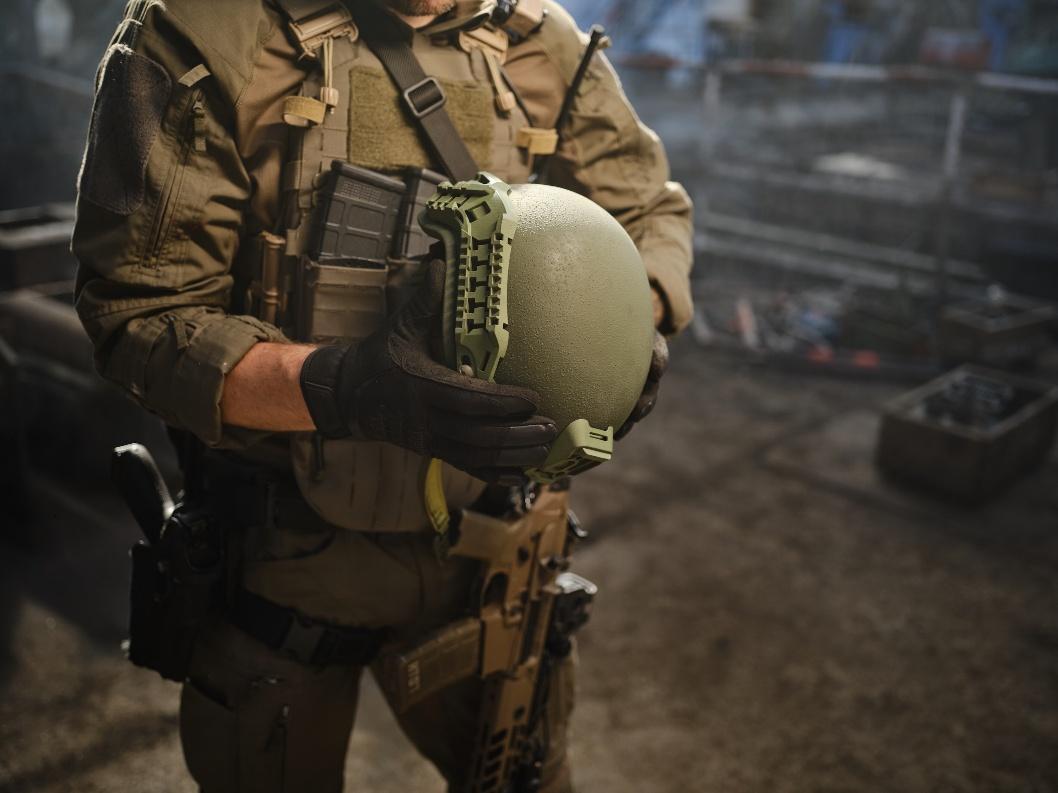
Strictly speaking, no.
The industry generally uses the term bullet-resistant rather than “bulletproof”, and for good reason.
Every ballistic helmet is tested against specific threats under defined test conditions: particular projectiles, velocities, impact locations and test methods. A helmet designed to stop a handgun round, for example, should not automatically be assumed to stop a rifle round.
That is why professional helmet specifications use protection levels and test standards rather than a simple “bulletproof” label.
What Do NIJ IIIA, VPAM 3 and STANAG 2920 Mean?
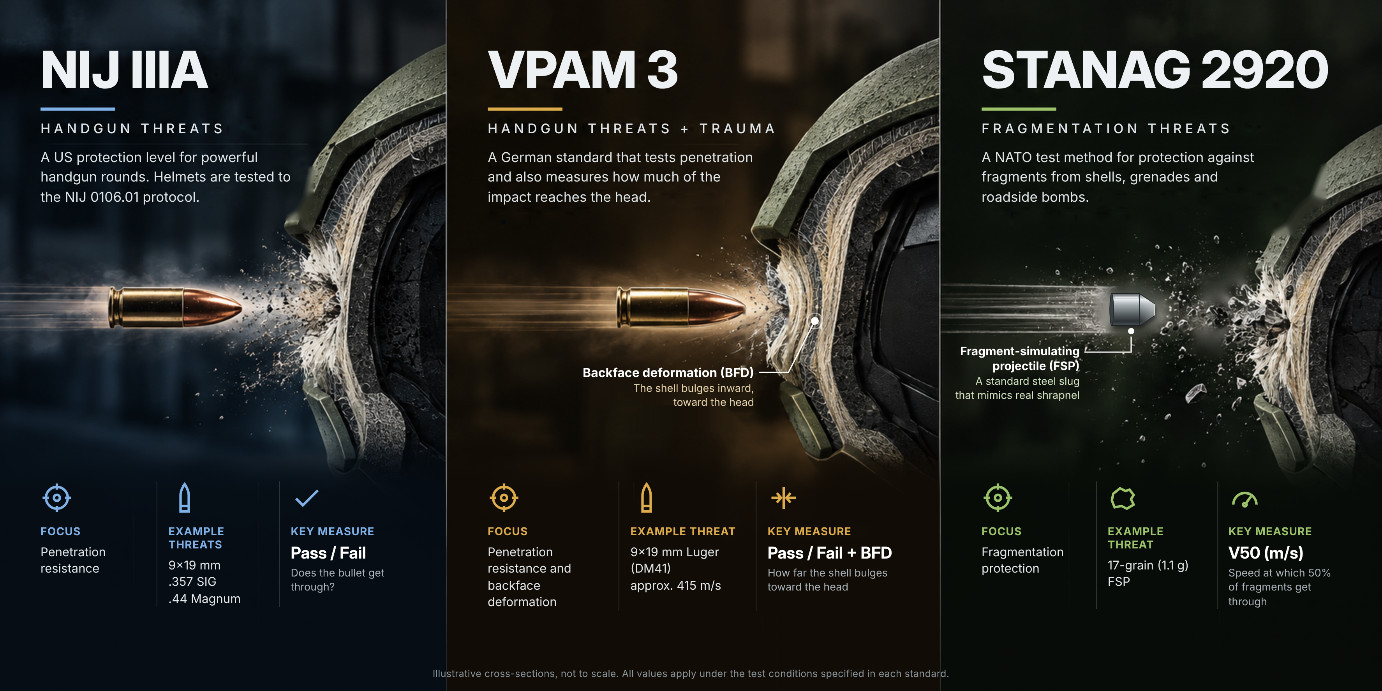
These are some of the standards and test methods you may encounter when evaluating ballistic helmets. Think of them as different exams, each designed to measure a particular aspect of protection.
NIJ IIIA
NIJ IIIA is an American ballistic protection level commonly associated with protection against powerful handgun threats.
It is essentially a penetration-resistance assessment: under the specified test conditions, does the projectile penetrate the protective system?
VPAM 3
VPAM 3 is a European ballistic protection classification used for personal protective equipment.
In addition to penetration resistance, VPAM test procedures can evaluate the deformation and effects associated with the impact, providing a broader picture of how the protective system performs under ballistic loading.
For users who need more than simple penetration resistance, this distinction matters.
STANAG 2920
STANAG 2920 is a NATO test method used to assess protection against fragmentation threats.
This is particularly relevant for military applications. Explosions can produce high-velocity fragments from shells, grenades and other sources, making fragmentation protection a critical part of battlefield survivability.
For many military users, therefore, a helmet's fragment protection performance can be just as important as its resistance to handgun threats.
What Does V50 Mean on a Helmet Specification Sheet?
If you have ever looked at a ballistic helmet specification sheet, you have probably seen the term V50.
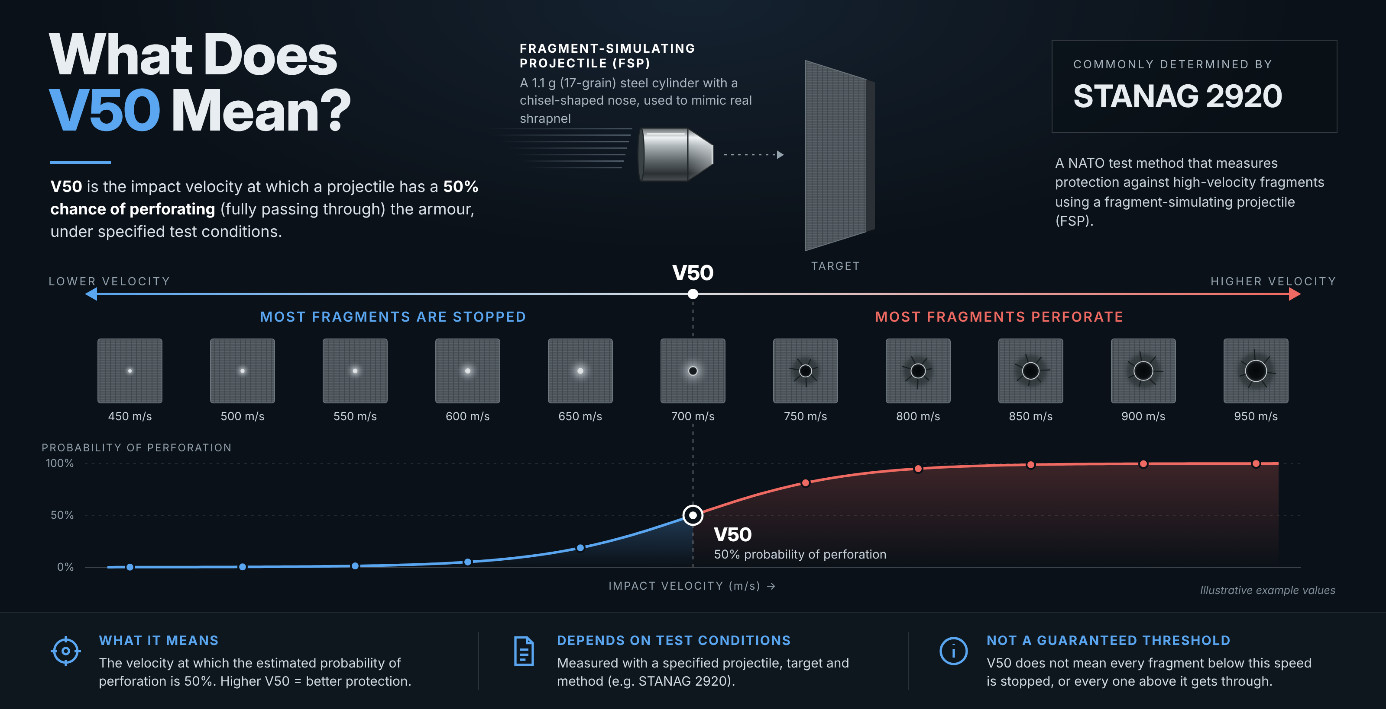
V50 is a ballistic limit velocity used in fragmentation testing.
In simple terms, it represents the velocity at which the probability of penetration is approximately 50% under the specified test conditions. The precise test method and calculation procedure matter, which is why V50 values should always be considered together with the relevant standard and test conditions.
The key principle is simple:
The higher the V50, the greater the resistance to fragment penetration under the specified test conditions.
This is why V50 is an important figure when comparing fragmentation protection between helmets.
What Is Backface Deformation, and Why Does It Matter?
This brings us back to the opening question:
How can a helmet stop a bullet and still cause an injury?
Imagine a goalkeeper stopping a powerful shot. The ball does not get through the glove, but the goalkeeper's hand still absorbs the force of the impact.
A ballistic helmet works in a similar way.
When a projectile strikes the shell, the material absorbs and dissipates energy. The shell may deform inward for an instant toward the wearer's head. This is known as backface deformation (BFD).
If the deformation is excessive, the resulting blunt impact can contribute to serious injury even when the projectile itself does not penetrate.
This is why ballistic protection is not simply about stopping the projectile.
A high-performance helmet should also manage the energy of the impact and limit deformation toward the wearer's head.
When comparing helmets, a lower measured BFD value generally indicates less deformation under the relevant test conditions.
Why Helmet Weight Matters
Most modern ballistic helmets are designed to balance protection with weight, typically falling somewhere around 1 to 1.7 kg, depending on the model, size, cut, accessories and protection level.
That may not sound heavy when you pick one up.
Wear it for ten hours, however, and the story changes.
Helmet weight affects more than comfort. A heavy or poorly balanced helmet can contribute to neck strain and fatigue. Additional equipment can make the problem more noticeable.
Night-vision systems, for example, are mounted towards the front of the helmet and can shift the centre of gravity forward.
That is why good helmet design is about more than the shell itself.
Protection, weight, balance, stability and equipment integration all matter.
A well-designed helmet should remain secure and comfortable when the wearer runs, kneels, turns quickly or operates for extended periods.
High Cut vs Full Cut: What’s the Difference?
You will often see ballistic helmets described as high cut, mid cut or full cut.
The terms describe how far the helmet shell extends down around the sides of the head and ears.
- Full cut helmets provide greater coverage around the sides of the head and ears, making them suitable when maximum coverage is a priority.
- High cut helmets are trimmed higher around the ears, creating space for over-ear communication headsets and other equipment.
- Mid cut helmets sit between the two approaches, offering a balance between coverage and equipment integration.
There is no single “best” cut.
The right choice depends on the mission, threat environment, communication requirements and the equipment the operator needs to carry.
One Material, Three Different Missions: CES Ballistic Helmets
There is no single ballistic helmet that is perfect for every mission.
Different users face different threats, operate in different environments and require different combinations of protection, weight, coverage and equipment integration.
At CES Armour, we take a threat- and mission-specific approach to personal protection.
Our ballistic helmet portfolio uses lightweight UHMWPE technology and is designed around the different operational requirements of military, law-enforcement and tactical users.
LEGACY — Fragmentation Protection
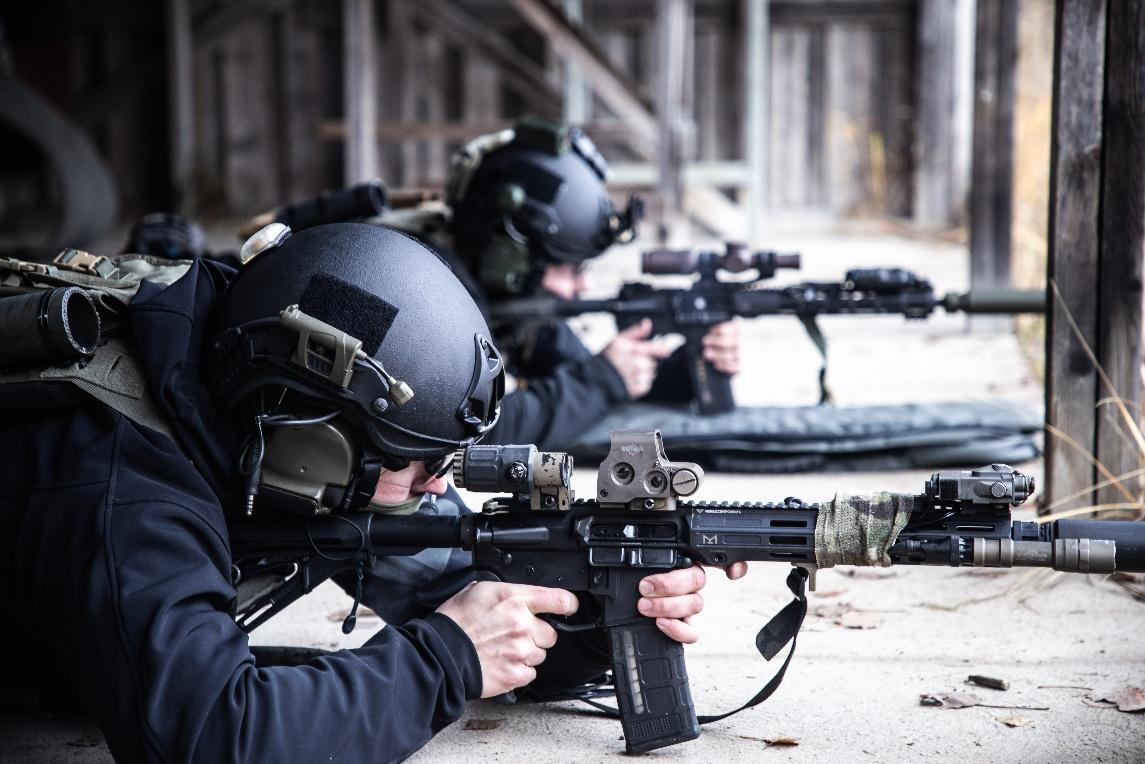
The Legacy series is focused on high-performance fragmentation protection.
Depending on the model, fragment protection ranges from 700 m/s to more than 910 m/s, with higher levels achievable with additional protection plates.
The PPH 400 and PPH 500 models offer backface deformation below 20 mm under the relevant test conditions.
The Ultra Light configuration weighs approximately 1.10 kg fully equipped, and less than 1 kg without accessories.
The Legacy family is available in high, mid and full cut configurations, allowing users to select the balance between coverage, weight and equipment integration that best suits their mission.
RAVEN — Protection for Demanding Environments
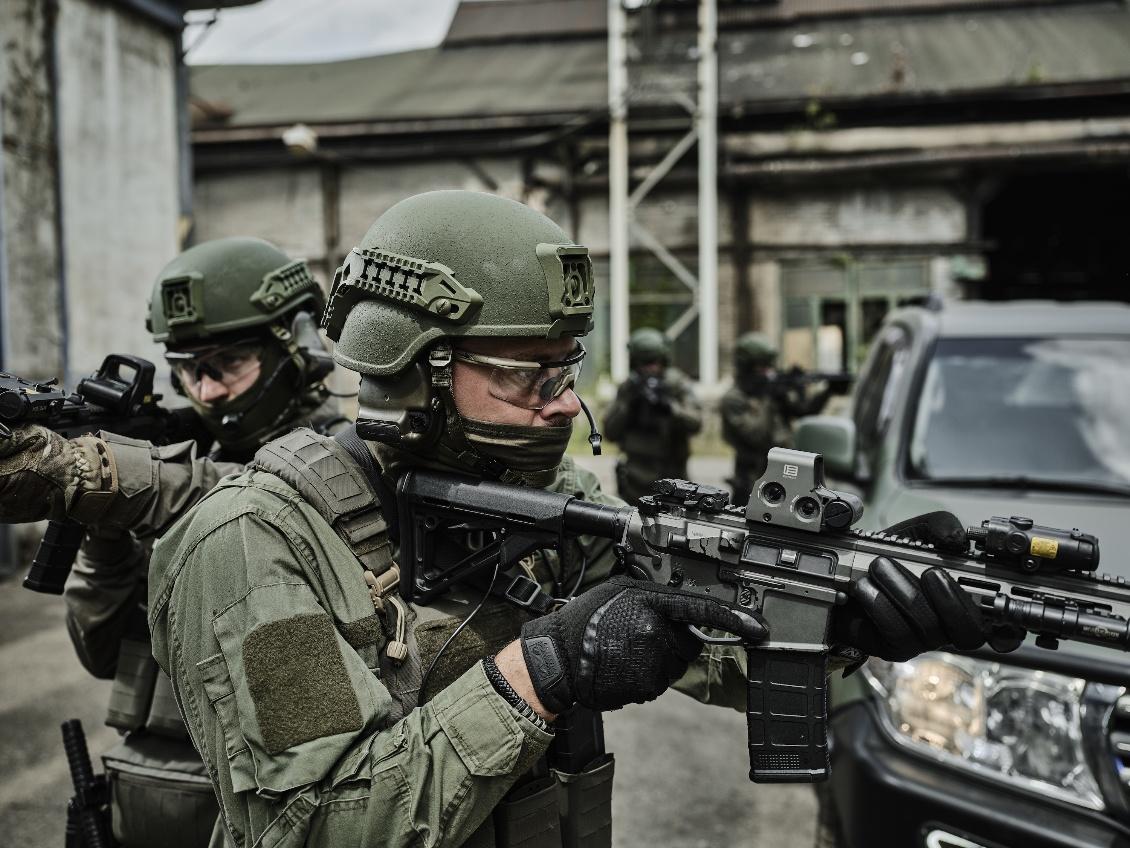
The RAVEN is designed for demanding operational environments where durability, environmental resistance and blunt-impact performance are critical.
It is rated for temperatures from −50°C to +71°C and designed for applications including parachute operations, vehicle use and dismounted missions.
The RAVEN also incorporates blunt-impact protection testing, with a HIC value below 1,000 under the relevant test conditions.
With a weight range of approximately 1.18–1.35 kg, the full-cut design provides increased coverage while maintaining a lightweight platform.
ARCHEON — Advanced Ballistic Protection
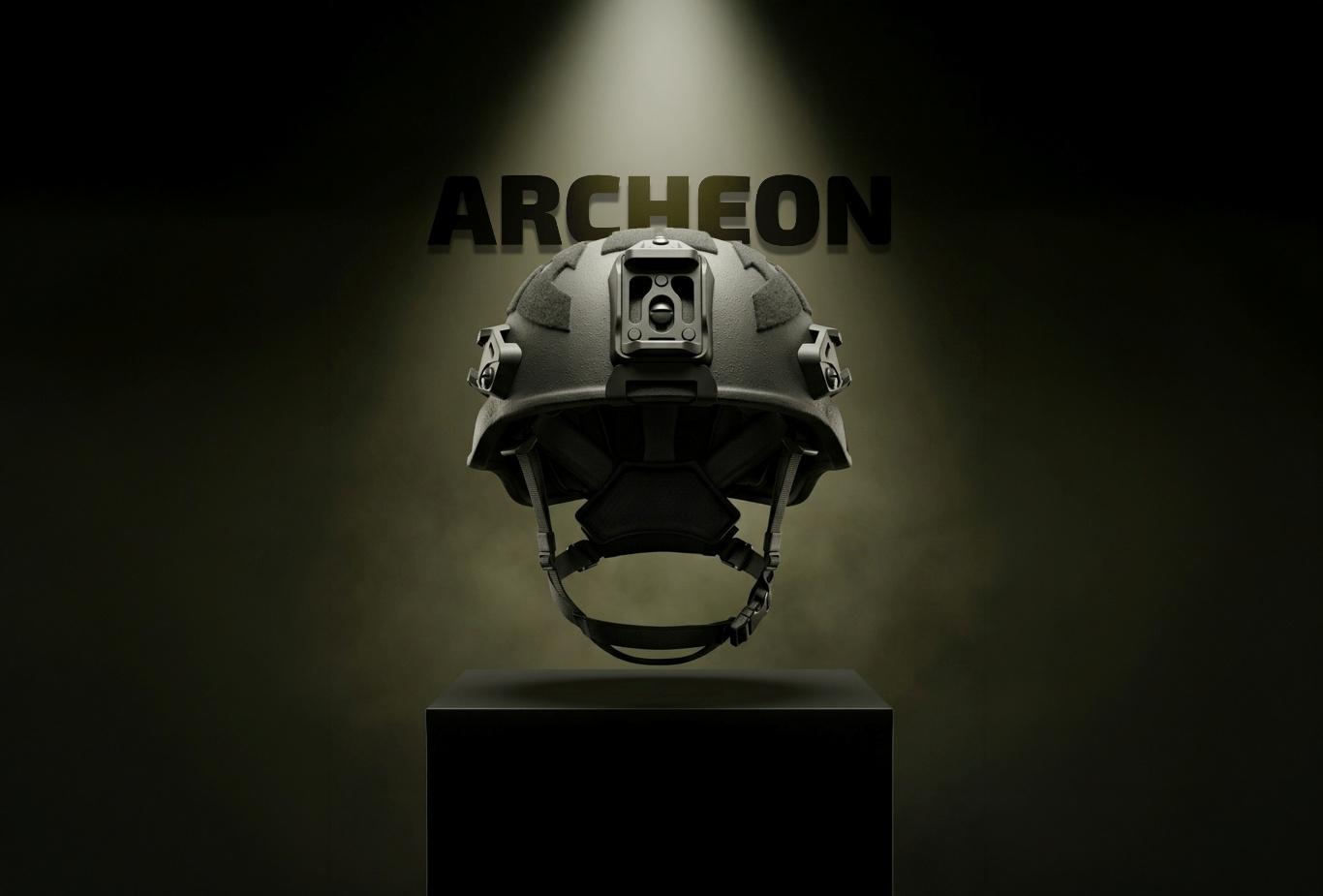
ARCHEON is designed for users who require enhanced ballistic protection in a lightweight helmet platform.
The helmet is certified to VPAM 3 and tested against specified handgun threats. It has also been tested under both dry and underwater conditioning, reflecting the demanding environments in which tactical equipment may be required to operate.
Its high-cut configuration allows integration with modern communication and mission equipment, making ARCHEON particularly suited to law-enforcement and tactical applications.
So, What Makes a Good Ballistic Helmet?
A ballistic helmet should never be judged by one number alone.
Stopping a projectile is only part of the equation.
The right helmet needs to combine:
- Ballistic protection
- Fragmentation resistance
- Controlled backface deformation
- Low weight
- Stable and balanced fit
- Appropriate coverage
- Communication and equipment integration
- Environmental durability
- Mission-specific performance
Ultimately, the best helmet is not simply the one that stops the most powerful threat.
It is the one that provides the right level of protection for the mission, without adding unnecessary weight or compromising the operator's ability to perform.
Frequently Asked Questions
Can a ballistic helmet stop a rifle bullet?
Most standard ballistic helmets are designed primarily for handgun and fragmentation threats rather than direct rifle-fire protection.
Some helmets can incorporate additional protective solutions, but protection always depends on the specific configuration, threat and test standard. Always check the manufacturer's certified specifications.
What is the best material for a ballistic helmet?
Modern ballistic helmets commonly use aramid fibres or UHMWPE.
UHMWPE is particularly attractive for applications where weight is critical because of its excellent strength-to-weight performance.
However, material alone does not determine helmet performance. Construction, shell geometry, processing, testing and overall system design are equally important.
What is a good backface deformation value?
In general, lower is better, provided the comparison is made under the same test standard and conditions.
High-performance helmets can achieve BFD values around 20 mm or below, depending on the applicable test method and configuration.
How long does a ballistic helmet last?
Service life varies according to the manufacturer, material, storage conditions, environmental exposure and usage.
Always follow the manufacturer's specified service-life and inspection requirements.
A helmet should also be inspected after significant impact and replaced when required by the manufacturer's guidance.
Protection Designed Around the Mission
At CES Armour, ballistic protection is not about choosing between protection and performance.
It is about engineering the right balance between survivability, weight, mobility and operational capability.
Our ballistic protection solutions are developed and tested against internationally recognised standards through CES's dedicated ballistic testing capabilities, complemented by independent testing at internationally accredited laboratories to ensure robust and reliable performance validation.
For detailed specifications, test documentation and application-specific requirements, contact the CES team at sales@cesarmour.co.uk.
