

Why most body armour vests aren't built for rifle rounds
The vest a police officer wears on patrol is usually built for one kind of threat: handgun rounds.
Most soft armour vests are designed primarily for handgun threats and do not provide the rifle protection offered by appropriately rated hard armour plates. A rifle bullet typically travels at more than twice the speed of a common handgun bullet and carries far more energy. Stopping it takes a different kind of armour.
That's why soldiers and tactical officers often wear something extra: hard armour plates. Here's how they work, what their ratings mean, and why choosing one is always a balance between protection and weight.
What is a body armour plate?
Body armour comes in two main types:
- Soft armour is the flexible vest most people picture. It's made from layers of high-strength fibre and is mainly designed for handgun rounds and fragments.
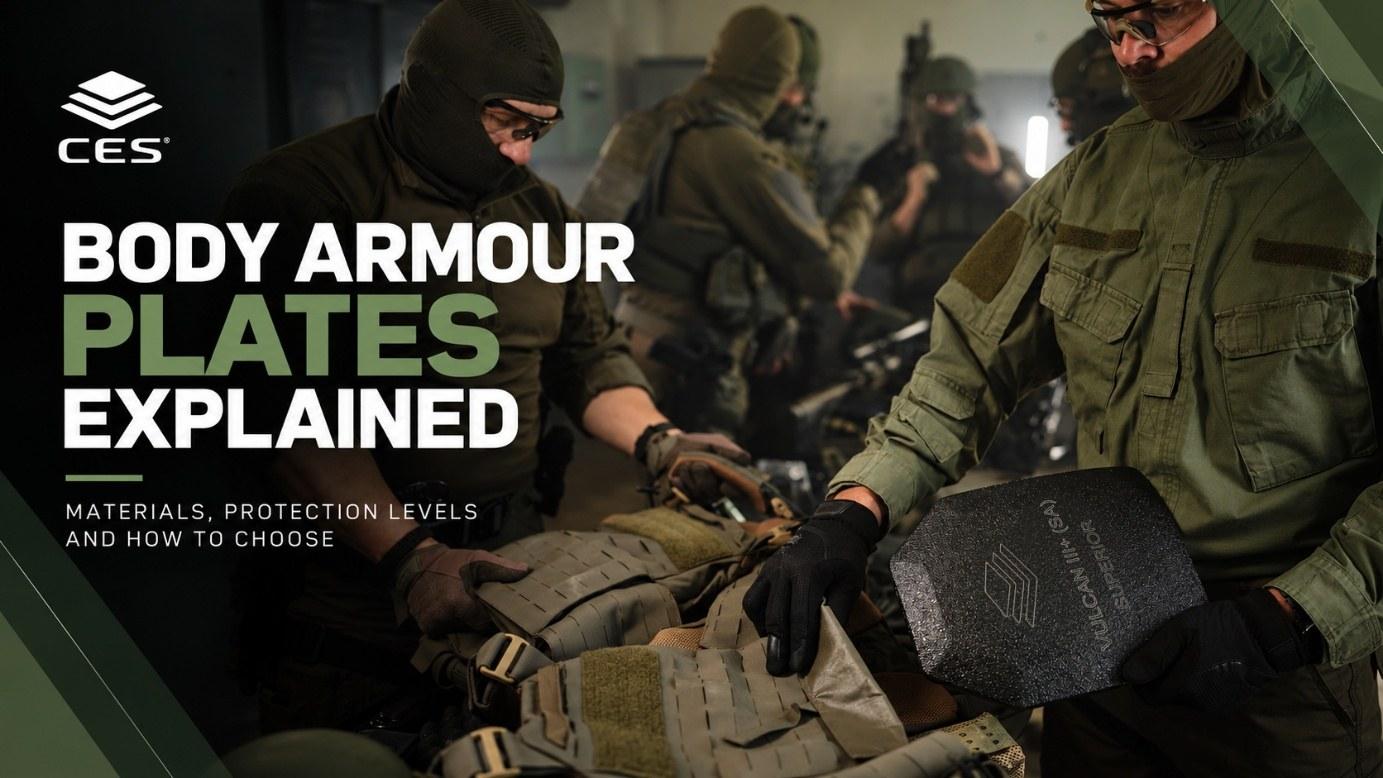
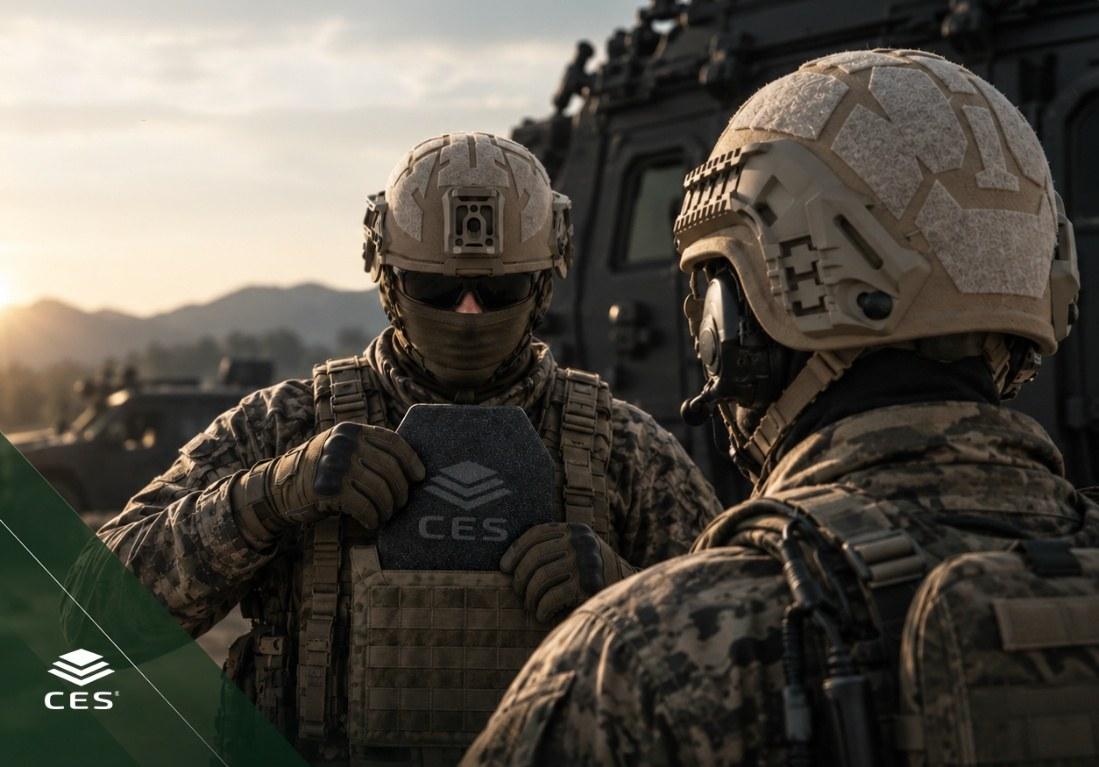
- Hard armour consists of rigid plates, also called inserts. They slide into pockets in a vest or plate carrier, usually over the chest and back, to provide rifle protection.
Plates don't cover the whole torso. They protect the area that matters most: the heart, lungs and major blood vessels. That's why their size and position are so important.
What are armour plates made of?
Plates are usually built around one of three material families, each with its own strengths and trade-offs:
- Steel is durable and thin but relatively heavy. Without a suitable coating, bullet fragments can deflect off the surface on impact. This is known as spall.
- Ceramics (such as alumina, silicon carbide or boron carbide) are very hard. They break up and erode the incoming projectile. They are normally combined with a backing layer that catches the remaining fragments and absorbs energy.
- Polyethylene and advanced composites offer a high strength-to-weight ratio. They stop projectiles by spreading and absorbing impact energy through many layers of fibre. They are often used alone or as the backing for other materials.
In practice, the material is only part of the story. A plate's real performance depends on its overall design: the combination and thickness of layers, its shape, and the specific threat it was tested against. Two plates made from similar materials can perform very differently.
What do Level III, Level IV and RF1–RF3 mean?
Protection levels tell you what kind of ammunition a plate has been tested against. The most widely quoted system comes from the US National Institute of Justice (NIJ), and it was recently updated.
The older terminology (NIJ 0101.06), still widely used across the market:
- Level III: rifle protection against threats such as the 7.62×51 mm NATO full-metal-jacket round.
- Level IV: the highest plate level under the older standard, tested against armour-piercing rifle ammunition (a .30-06 round with a hardened steel core).
The current terminology (NIJ 0101.07 and NIJ 0123.00):
- RF1: broadly corresponds to the former Level III.
- RF2: a new level that adds certain 5.56 mm rifle threats which older Level III plates were not required to stop.
- RF3: broadly corresponds to the former Level IV.
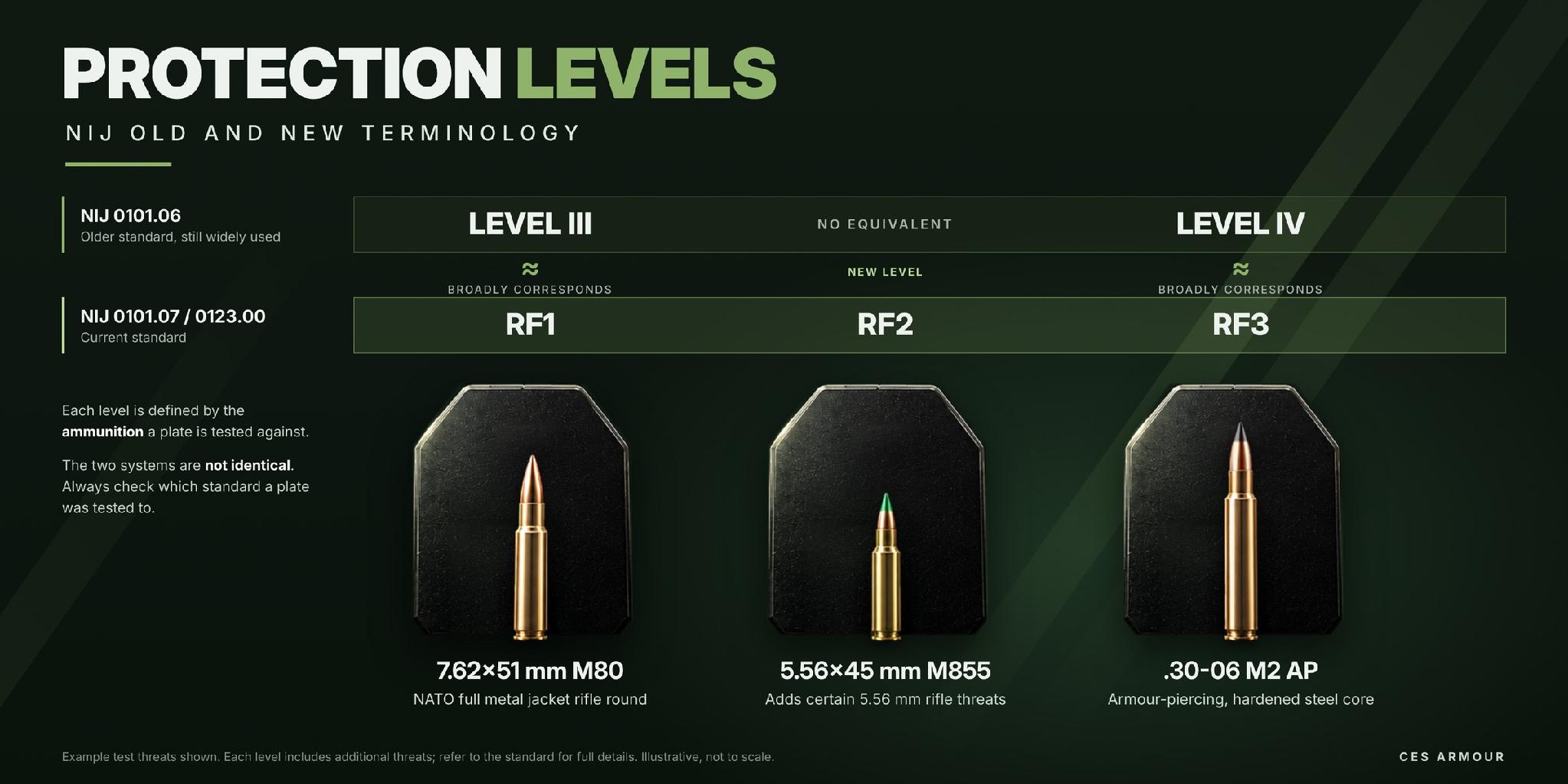
You will see both naming systems side by side for some time. You may also see "Level III+" or "III++". These were never official NIJ levels. Manufacturers use them to indicate protection against threats beyond Level III, so it's always worth checking exactly which rounds a plate was tested against.
The NIJ isn't the only authority. Europe uses others, such as the German VPAM guidelines and the UK Home Office standards developed by HOSDB, now CAST. Each tests against its own list of threats and conditions.
What do "stand-alone" and "ICW" mean?
You'll often see these labels on plate specifications:
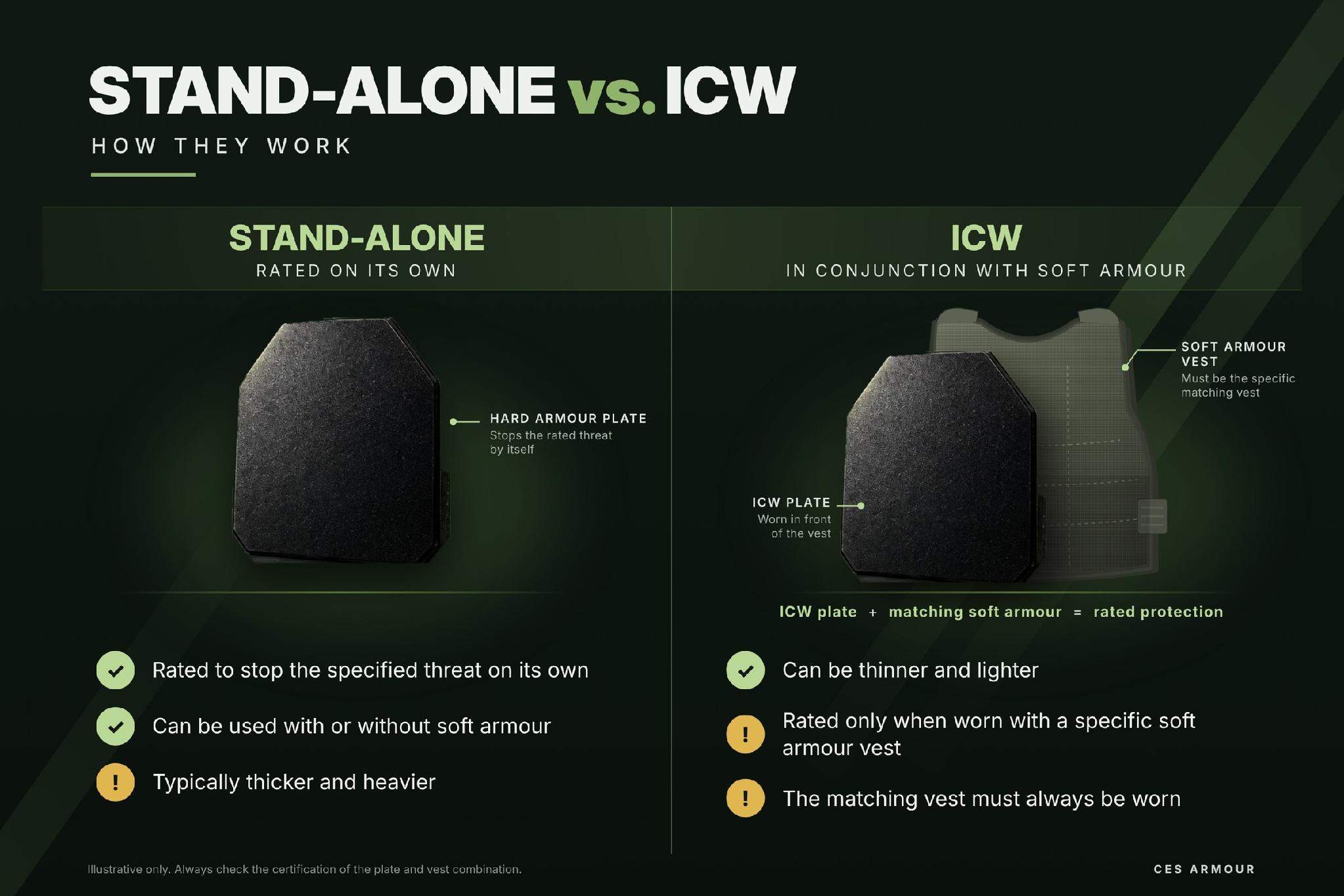
- Stand-alone plates are rated to stop the specified threat on their own.
- ICW (In Conjunction With) plates are only rated when worn over a specific soft armour vest. Together, the plate and vest stop the threat.
ICW plates can be thinner and lighter, but only if the user always wears the matching vest. That's a detail procurement teams need to check carefully.
What is a multi-hit plate?
In the real world, armour may be hit more than once. Multi-hit performance refers to a plate's ability to resist multiple impacts under a defined test protocol. The required number, spacing and conditions of impacts depend on the applicable standard, protection level and plate configuration.
So when you compare two "multi-hit" plates, always check the test behind the claim. A rating against one threat at one level doesn't automatically carry over to another.
What happens to the body behind the plate?
Stopping a bullet is only half the job.
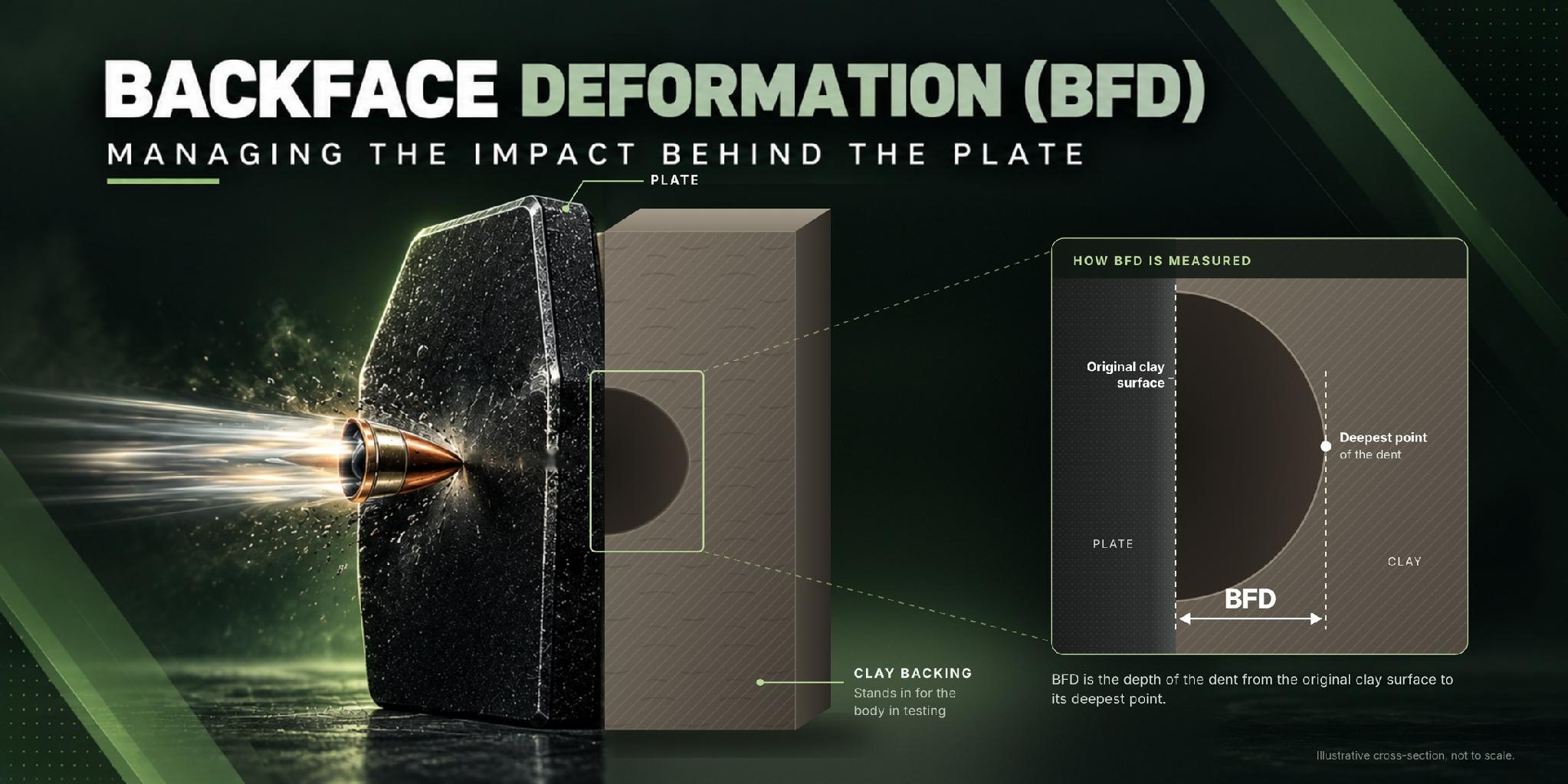
When a plate stops a round, it flexes inward toward the body. This is called backface deformation (BFD). In many test methods, the plate is placed in front of a block of modelling clay, and the depth of the dent left behind is measured. Each standard sets its own limit. Under NIJ 0101.06, for example, the limit is 44 mm under its specified test conditions.
Backface deformation is an important indicator of a plate's impact response, but it does not by itself determine the full risk of injury behind the armour. The threat, the impact location and the wearer's own equipment also play a part.
How heavy are armour plates?
Plate weight varies widely with protection level, material and size. Lighter rifle plates can weigh around 1 kg, while plates rated against armour-piercing threats are typically considerably heavier. Most users wear at least two plates, front and back, and some add side plates. The weight adds up quickly, before any other equipment is counted.
Weight shapes everything: how fast an operator can move, how long they can stay on task, and how tired they are when it matters most. That's why the industry keeps working toward the same goal: more protection for less weight.
Why are plates curved?
A flat plate is easier to make, but the human torso isn't flat. Plates come in different curvatures:
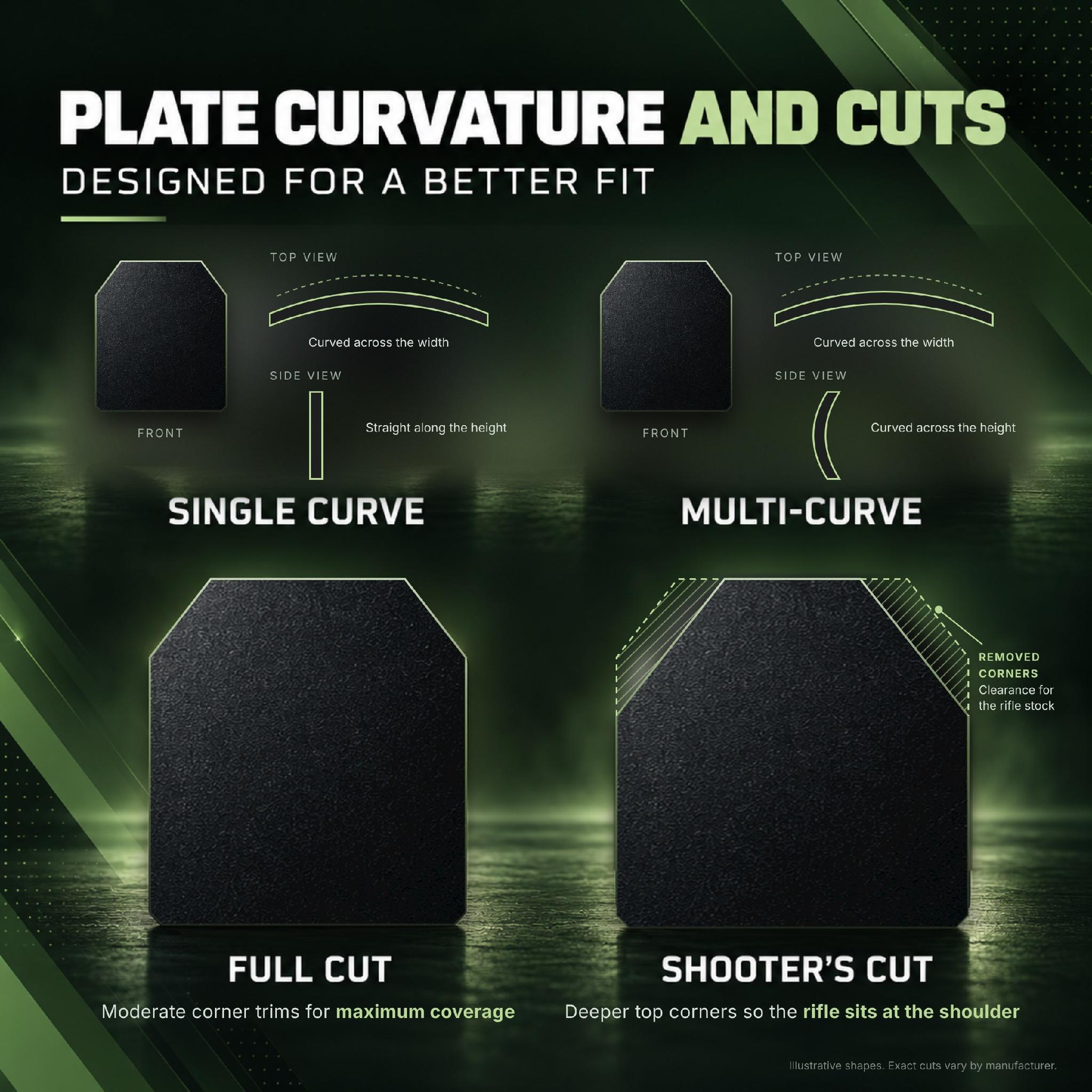
- Single curve: curved across the width of the plate.
- Multi-curve: curved across both the width and the height, so the plate follows the body more closely.
A closer fit spreads the weight more evenly, makes the plate more comfortable and helps keep it in the right place. Plates also come in different cuts. For example, a "shooter's cut" has angled top corners, so the wearer can bring a rifle up to the shoulder more easily.
How to choose the right plate
Bringing it all together, a sound plate choice starts with a few questions:
- What threats will the wearer face? This determines the protection level, and which standard it should be tested against.
- Stand-alone or ICW? If ICW, will the matching vest always be worn?
- How is multi-hit performance defined? Check the test protocol behind the claim.
- What happens behind the plate? Look at backface deformation data where it is available.
- How long will it be worn, and by whom? Weight, curvature and cut matter as much as the rating.
VULCAN® inserts: one platform, three series
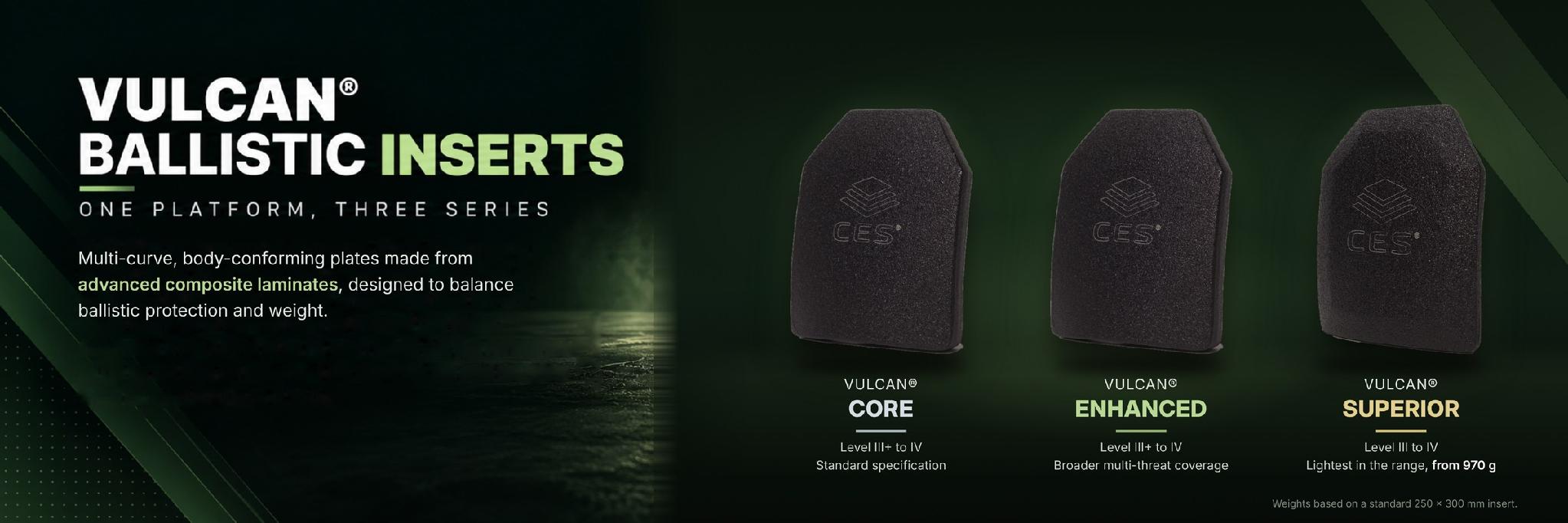
At CES, our VULCAN® ballistic inserts are built around these same trade-offs. They are multi-curve, body-conforming plates made from advanced composite laminates, designed to balance ballistic protection and weight while managing impact energy behind the plate.
The range comes in three series:
- VULCAN® CORE: the standard specification, offering cost-effective protection from Level III+ to IV.
- VULCAN® ENHANCED: upgraded specifications with broader multi-threat coverage, tested against a wider mix of ammunition types at each level.
- VULCAN® SUPERIOR: the lightest plates in the range, with Level III and III+ configurations weighing around 970 g.
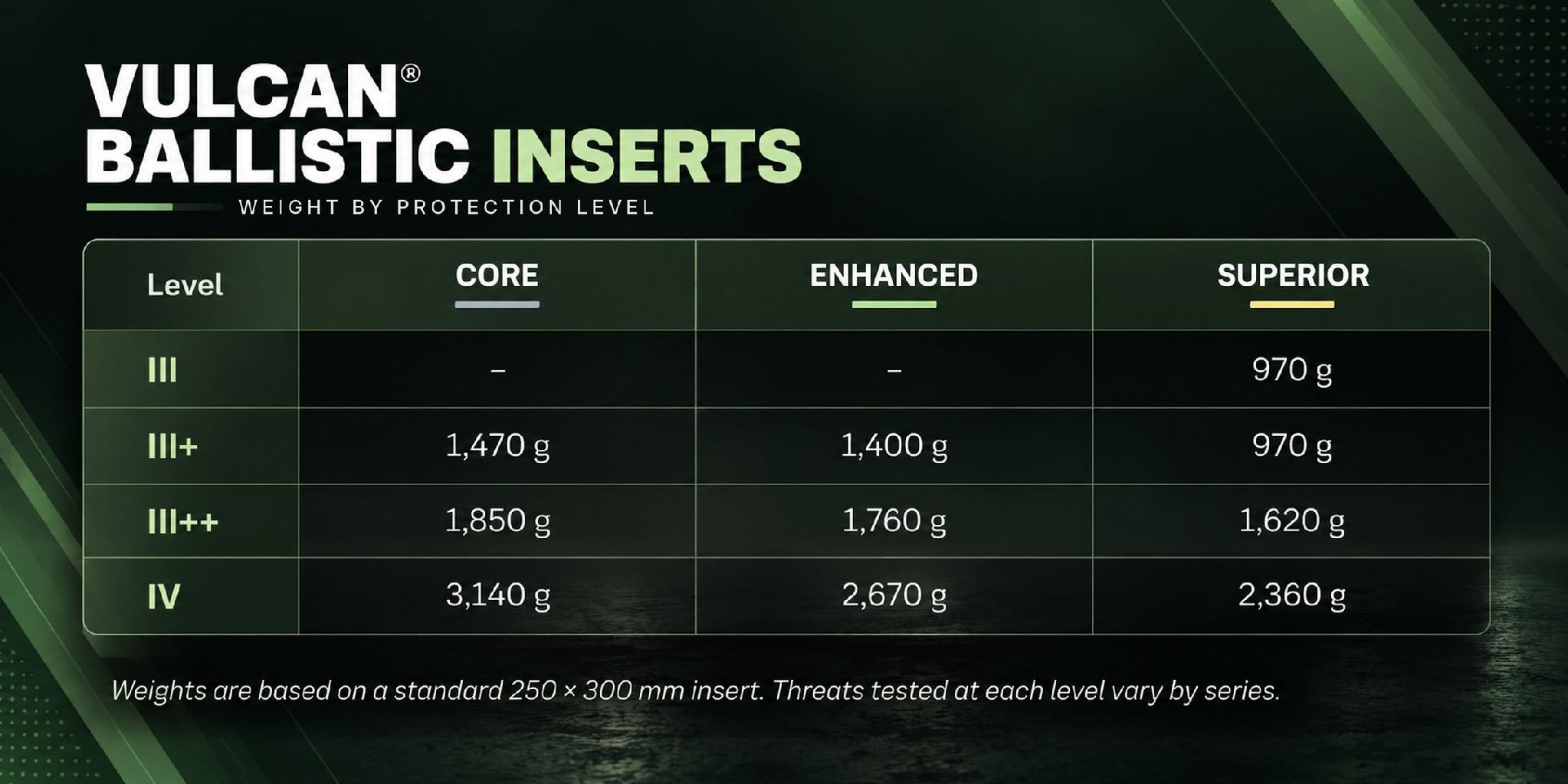
| Level | CORE | ENHANCED | SUPERIOR |
|---|---|---|---|
| III | – | – | 970 g |
| III+ | 1,470 g | 1,400 g | 970 g |
| III++ | 1,850 g | 1,760 g | 1,620 g |
| IV | 3,140 g | 2,670 g | 2,360 g |
Weights are based on a standard 250 × 300 mm insert. Threats tested at each level vary by series.
Level III+ and III++ configurations across all three series offer multi-hit performance of up to six hits. At Level IV, multi-hit performance varies by series and threat. The VULCAN® portfolio has been tested and qualified against international standards including NIJ 0101.04, NIJ 0101.06, VPAM, HOSDB and CAST. The exact rating, test standard and multi-hit performance of each plate are set out in its technical documentation.
Front, back and side plates are available, and alternative sizes, cuts, curvatures and protection levels can be specified to match particular carriers and operational requirements.
Frequently asked questions
What's the difference between body armour and a plate?
"Body armour" covers both soft vests and hard plates. A plate is the rigid insert that adds rifle protection to a vest or plate carrier.
Is Level IV the same as RF3?
Not exactly. RF3 broadly corresponds to the former Level IV and covers armour-piercing rifle threats, but the two standards differ in their test requirements. Always check which standard a plate was tested against.
Can a Level III (RF1) plate stop armour-piercing rounds?
Generally no. Armour-piercing rifle ammunition is covered by Level IV, now RF3.
Is a heavier plate always better?
Not necessarily. Protection depends on materials, design and the threats a plate was tested against, not on weight alone.
Do armour plates expire?
Plates have a recommended service life, which varies by manufacturer and material. Any plate that has been hit or shows damage should be inspected and replaced in line with the manufacturer's guidance.
For full specifications, test data and certification documentation, government and defence customers can contact the CES team at sales@cesarmour.co.uk.